
Remittances Without Rights: How India's Foreign Policy Abandoned Its Working -Class Gulf Diaspora

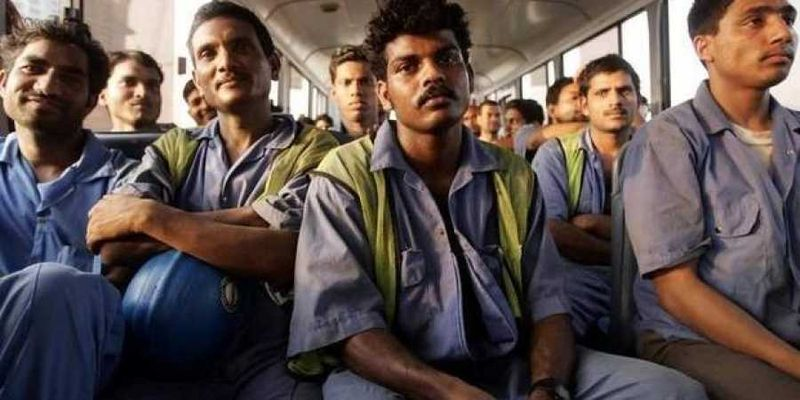
The Workers Behind the Statistic
India received $125 billion in remittances in 2023, retaining its position as
the world's largest recipient of inward transfers, according to the World Bank's Migration and Development Brief. The figure anchors the national balance of payments, which keeps families afloat in the agrarian heartlands of states like Uttar Pradesh, Bihar, Rajasthan, and Odisha, where few alternative income sources exist, and finances approximately 23.2 per cent of Kerala's Net State Domestic Product, according to the Kerala Migration Survey 2023. It is celebrated routinely in budget speeches and diplomatic briefings.
What is almost never mentioned is who produces it. Close to nine million Indians work in GCC countries (the Gulf Cooperation Council, a six-member regional bloc of Arab states formed in 1981 spanning Saudi Arabia, the UAE, Qatar, Kuwait, Oman, and Bahrain), according to the figures compiled by India's Ministry of External Affairs. However, the nature of that work rarely matches the image India projects of its diaspora abroad. The majority are not the software engineers or finance professionals that populate India's diaspora narrative. According to the ILO's India Labour Migration Update, over 90% of Indian ECR-cleared workers heading to the Gulf are semi-skilled or unskilled construction workers, domestic helpers, drivers, and cleaners who together account for roughly 70% of the total Indian migrant population across GCC states. Their migration is governed not by professional opportunity but by economic necessity:
The wage differential between what these workers can earn at home and what Gulf employers offer remains the overwhelming driver of departure. And yet the legal architecture that governs their stay abroad was not designed with their protection in mind a fact acknowledged by India's own Parliamentary Standing Committee on External Affairs, which found in 2019 that the current legal provisions are inadequate to deal with the issues confronting migrant workers, and by researchers who have documented the structural class asymmetry in Indian emigration policy robust diaspora engagement for the skilled and affluent, administrative gatekeeping for the low-wage.
The Kafala Cage
The defining feature of Gulf labour migration is the Kafala system, which binds a worker's legal right to remain in the country to a specific employer. In practical terms, this means that switching jobs, travelling home, or, in many cases, even seeking legal redress requires the employer's consent. The system makes exploitation structurally permissible: withheld wages, passport confiscation, and contract substitution are practices the International Labour Organisation has explicitly documented and required Gulf states to address as part of Kafala reform efforts across the region. For an Indian domestic worker in a Riyadh household or a construction labourer in a Doha labour camp, the practical consequence of Kafala is simple: leaving an abusive employer is illegal until the employer agrees to it.
These are not edge cases. The ILO formally lists retention of identity documents among its eleven indicators of forced labour, describing passport confiscation as one of the most common forms of coercion used to trap migrant workers across the Gulf. Wage abuse is equally systematic: India's own Ministry of External Affairs received 48,095 labour complaints from Indian workers across six GCC countries between 2019 and June 2023, with non-payment of wages the single most cited grievance. The workers most exposed to these conditions are, according to ILO data, the semi-skilled and unskilled majority who account for over 90 per cent of all ECR-cleared Indian workers in the Gulf.
Paper Protections: What India's Bilateral Agreements Actually Do
India has signed Bilateral Labour Agreements with all six GCC states. The Agreement on Labour Cooperation for Domestic Service Workers Recruitment, signed in January 2014 between the Ministry of Overseas Indian Affairs and the Saudi Ministry of Labour, is the most frequently cited. It was, notably, the first formal labour cooperation agreement India had ever entered into with the kingdom. On paper, it commits both governments to ensuring decent conditions, standard contracts, and timely wage payment. In practice, enforcement depends entirely on India's consular infrastructure, which is demonstrably insufficient for the scale of the problem.
Indian consulates and embassies across the Gulf operate with limited staffing and no independent monitoring authority. A worker who has had his passport withheld in a Riyadh suburb must physically reach the consulate, which may require his employer's permission under Kafala to leave the premises. The BLA provides a right on paper and no mechanism to exercise it in practice. Protective clauses that cannot be enforced are, functionally, not protections at all.
The 1983 Problem: A Law Built for a World That No Longer Exists
The legislation that governs Indian labour emigration is the Emigration Act of 1983, a statute enacted more than four decades ago, before the mass movement of low-wage workers to the Gulf became one of the defining features of India's political economy. The Act operates on a classification system that divides passport holders into those requiring an Emigration Check (ECR category, typically less educated workers) and those exempt from it. ECR workers are theoretically subject to additional pre -departure scrutiny. In practice, the system is porous, underfunded, and incapable of catching fraudulent recruitment before workers board their flights.
The e-Migrate platform, introduced in 2014 by the Ministry of External Affairs, attempted to digitise contract registration and emigration clearance for ECR workers. It was a meaningful administrative upgrade. What it could not do was fix the statutory problems it sat inside: an Act that contains no extraterritorially enforceable wage floor, the Minimum Referral Wage exists only as an administrative circular, verifiable at the point of departure but unenforceable once a worker is abroad; a compulsory insurance scheme (the Pravasi Bharatiya Bima Yojana) that sits outside the Act itself and whose coverage is so narrowly conditioned that deaths occurring during working hours are routinely classified as natural deaths, excluding families from any payout or repatriation cost cover; and repatriation provisions that depend entirely on whether the worker was recruited through a registered agent a condition that a significant portion of ECR workers do not meet. India's own Parliamentary Standing Committee on External Affairs noted in 2019 that the 1983 Act's legal provisions were inadequate to deal with the issues confronting migrant workers, a conclusion that has driven three successive attempts to replace it with new legislation, none of which has yet passed.
In January 2019, the Ministry of External Affairs published a draft Emigration Bill for public comment, formally recorded by PRS Legislative Research as seeking "to provide a regulatory mechanism to govern overseas employment of Indian nationals, and protect the welfare of Indian emigrants," acknowledging that the Emigration Act of 1983 was no longer adequate to govern the realities of Indian labour migration.
A Diaspora Policy Built for the Wrong Diaspora
India invests considerable political capital in its diaspora. The Pravasi Bharatiya Divas convention, the Overseas Citizenship of India card framework, and extensive diplomatic outreach to Indian communities abroad, all administered by the Ministry of External Affairs, are a testament to the government’s serious commitment to diaspora engagement.
The question is: which diaspora?
The OCI card cannot be held by Indian nationals and offers no protection to active migrants working abroad on temporary labour contracts, as the scheme is available exclusively to foreign nationals of Indian origin. The Pravasi Bharatiya Divas convention remains structurally oriented towards the professionally established diaspora, given that the Gulf diaspora has less lobbying power than those based in Western countries, unlike the diaspora in the United States, which is the wealthiest and most educated minority group in the country and plays a significant role in supporting India's bilateral relations there. Yet the economic contribution of Gulf workers is disproportionate: despite making up only about one-quarter of India's overseas population, Indian nationals in the Gulf states send almost 40 percent of the country's bank remittances. The asymmetry in political attention reflects a calculation about whose presence is diplomatically useful, and one cannot deny that the Indian diaspora in the Gulf has historically been neglected, even as they wire money home every month.
What the Gulf Is Doing With or Without India
The Gulf is not static. Saudi Arabia's Nitaqat programme, the labour nationalisation quota system operating under Vision 2030, has progressively tightened the sectors where Indian low -wage workers have historically concentrated. Construction, hospitality, and retail are all subject to Saudization targets that displace foreign workers regardless of individual performance or employer preference.
Qatar, following years of international pressure over the deaths of migrant workers during FIFA World Cup 2022 construction, introduced significant Kafala reforms between 2020 and 2022. Exit permit requirements were abolished, workers were granted limited rights to change employers without sponsor approval, and a Worker Support and Insurance Fund was established to address unpaid wage claims, according to the ILO's monitoring reports on Qatar's Labour reforms. Implementation remains uneven, but the direction of reform is real.
Federal Decree-Law No. 33 of 2021 introduced new employment contract categories, codified anti-discrimination provisions, and reduced, though did not eliminate, employer control over job mobility. On the ground, for an Indian worker in Dubai or Sharjah, the rules have changed. India's legal architecture for managing those changes has not.
What Serious Protection Would Look Like
The most instructive comparison is not within South Asia. It is the Philippines. Manila's Republic Act 8042 of 1995 - the Migrant Workers and Overseas Filipinos Act, created an institutional architecture that India has simply never built. The Overseas Workers Welfare Administration (OWWA), established under that statute and documented on its official portal, operates as a dedicated welfare agency funded through mandatory membership contributions from overseas workers and recruitment agencies. It is not perfect. But it is functional, financially sustainable, and structurally committed to the workers it serves.
India sends more workers abroad than the Philippines. It receives more remittances. It has a larger economy, a larger diplomatic service, and a Ministry of External Affairs with far greater resources. What it lacks is not capacity. It lacks the political decision to treat its working-class Gulf migrants as a constituency whose welfare matters beyond their remittance value.
A serious Indian response would replace the 1983 Act outright, revive and enact the 2019 Draft Policy, renegotiate BLAs with Qatar, Saudi Arabia, the UAE, and Kuwait to include independent monitoring mechanisms aligned with the ILO's Multilateral Framework on Labour Migration, and establish a dedicated welfare fund financed through recruitment agency levies. None of this is administratively complicated. All of it has been proposed before. The obstacle is not knowledge. It is the persistent, structural decision to let the money flow in while the people who send it remain unprotected.
Written By: Diya Singh
Edited By: Nilanjan Jha


Comments